
How Bullet Resistant Glass Manages Ballistic Energy
Bullet resistant glass does not rely on a single exceptionally strong layer to stop a projectile. It is an engineered laminate in which multiple materials work together to progressively manage the energy generated during ballistic impact.
When a projectile strikes the threat-side surface, the laminate begins a sequence of material responses. Glass fractures, impact energy spreads through the construction, interlayers transfer loads between adjacent materials, and polymer layers can deform as the projectile penetrates deeper into the laminate. Each stage contributes to reducing the projectile’s remaining energy until the defined ballistic threat is resisted.
 Ballistic Resistance Is an Energy-Management Problem
A moving projectile carries kinetic energy. When it encounters a bullet resistant laminate, that energy must be transferred away from the projectile without allowing complete penetration through the glazing.
This does not happen at a single point within the construction.
Instead, energy is progressively managed as additional layers become involved in the ballistic event. The exact response depends on the materials, thicknesses, layer sequence, interfaces, projectile threat, and overall laminate architecture.
Engineering Principle: Ballistic resistance is achieved by progressively managing kinetic energy—not by relying on a single layer to stop a projectile.
The Ballistic Impact Sequence
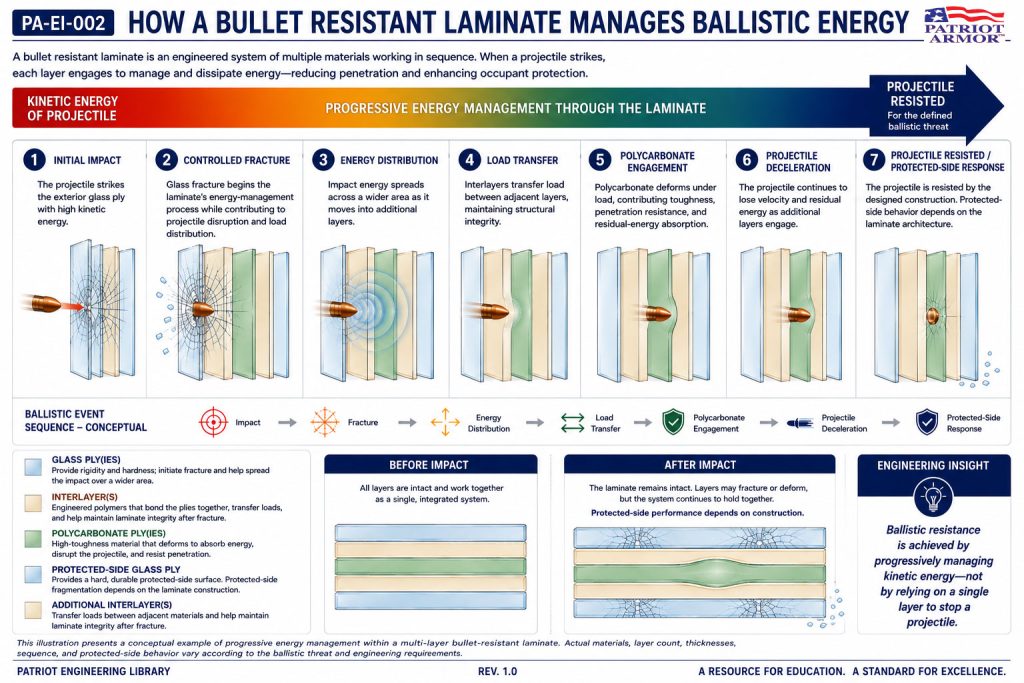
Although the physical response occurs extremely rapidly and is considerably more complex than any simplified diagram can show, the process can be understood as a sequence of interacting events.
1. Initial Impact
The projectile first encounters the exterior glass ply with concentrated kinetic energy.
The hardness and rigidity of the glass contribute to the initial interaction with the projectile while fracture begins the laminate’s energy-management process.
2. Controlled Fracture
Glass fracture is not necessarily an indication that the laminate has failed.
Fracture allows the affected glass plies to participate in the impact response while helping distribute concentrated loads into a broader portion of the laminate.
The surrounding interlayers help retain fractured material and maintain engagement between adjacent layers.
3. Energy Distribution
As the projectile moves farther into the laminate, the impact is no longer confined to the original point of contact.
Energy spreads across a wider area and begins engaging additional materials within the construction.
This progressive involvement of the laminate is an important part of ballistic energy management.
4. Load Transfer
Interlayers do more than simply bond the individual plies together.
They help transfer loads between adjacent materials, maintain layer engagement, retain fractured glass, and allow the laminate to continue behaving as an integrated system as damage develops.
The interfaces between materials therefore become an important part of the laminate’s response.
5. Polycarbonate Engagement
When polycarbonate is incorporated into a ballistic laminate, its toughness and ability to deform can make an important contribution to energy absorption and penetration resistance.
Rather than responding like brittle glass, polycarbonate can deform substantially under load. This allows it to participate differently in the energy-management process as the projectile penetrates farther into the construction.
6. Projectile Deceleration
As progressively more of the laminate becomes engaged, the projectile continues to lose velocity and energy.
Glass fracture, load distribution, interlayer behavior, polymer deformation, and the interaction between the individual layers all contribute to the response of the complete construction.
The projectile may penetrate through multiple individual layers before ultimately being stopped.
7. Projectile Resisted
For the defined ballistic threat, a properly engineered and tested construction prevents complete projectile penetration through the glazing.
The projectile can therefore travel significantly into the laminate while still being successfully resisted by the overall construction.
This distinction is important: successful ballistic performance does not require the projectile to stop at the first surface or within the first layer.
What Happens to the Laminate After Impact?
A bullet resistant laminate can experience significant permanent damage while still successfully performing its intended ballistic function.
Glass layers may fracture extensively. Interlayers can stretch and transfer loads. Polycarbonate may deform substantially around the impact area. The projectile itself may also deform as energy is transferred through the construction.
The laminate does not need to remain visually unchanged to demonstrate successful ballistic resistance.
What matters is whether the complete tested construction satisfies the performance requirements associated with the defined ballistic threat.
Protected-Side Response Is a Separate Consideration
Stopping the projectile is only one part of understanding ballistic glazing performance.
The protected-side response can vary depending on laminate architecture. A construction with a protected-side glass surface may exhibit glass fracture and fragment release near the impact area, while a construction incorporating a protected-side fragment-retention material or technology may behave differently.
This is why ballistic resistance and spall performance should be considered as related but separate characteristics.
Engineering Insight: The ballistic rating tells us whether the defined projectile threat was successfully resisted. Protected-side performance tells us what occurred on the opposite side of the laminate while that happened.
Why the Complete Construction Matters
The individual materials in bullet resistant glass contribute different properties, but those properties alone do not establish ballistic performance.
Glass can provide hardness and rigidity. Interlayers provide adhesion, load transfer, and layer engagement. Polycarbonate can provide toughness, deformation, and penetration resistance.
But ballistic performance belongs to the complete tested construction.
Changing the thickness of a material, the number of plies, the interlayer system, the sequence of the materials, or another element of the laminate architecture can change how energy moves through the system.
Two laminates can therefore use many of the same materials and still behave differently during ballistic impact.
A Conceptual Model, Not a Universal Construction
The PA-EI-002 illustration presents a conceptual example of how energy can be progressively managed within a multi-layer bullet resistant laminate.
It should not be interpreted as a universal laminate recipe.
Actual constructions can vary considerably in material selection, layer count, individual ply thickness, interlayer technology, protected-side architecture, overall thickness, and weight depending on the ballistic threat and other engineering requirements.
The important concept is not the exact number of layers shown in the illustration.
It is that the layers work together as an integrated system to progressively manage ballistic energy.
Key Takeaway
Bullet resistant glass works through the coordinated response of multiple materials.
The projectile initiates fracture and deformation as it penetrates the laminate. Energy is distributed through additional layers, loads are transferred across material interfaces, polymers deform, and the projectile progressively loses energy.
No individual layer explains the ballistic performance of the system.
Materials contribute properties. The complete tested construction establishes demonstrated ballistic performance.
Continue Learning
- PA-EI-001 — Anatomy of a Bullet Resistant Laminate
Explore how glass, polycarbonate, and interlayers are arranged within a representative multi-layer ballistic construction. - PA-EI-003 — Understanding Spall and Protected-Side Response
Learn why stopping the projectile and controlling what occurs on the protected side are separate performance considerations. - PA-EF-001 — What Is Bullet-Resistant Glass?
Review the fundamental principles behind ballistic glazing and the different families of bullet resistant constructions. - PA-EF-004 — Understanding Spall
Explore rear-face fragmentation and the different engineering approaches used to manage protected-side response. - PA-ED-002 — Every Layer Has a Job
Learn how glass, interlayers, polycarbonate, acrylic, and other materials contribute different properties to engineered security glazing.